
September 16, 2026 | All Resources, Blog
A sales kickoff can have a strong keynote and still break down everywhere around it.
Months of work go into the content, while the attendee experience is often decided by the operational systems carrying it. A rep who lands the night before and cannot find a breakout assignment has already formed an opinion about how the week will run, and it has nothing to do with the keynote.
A sales kickoff, or SKO, is expensive, highly visible, and important enough that it should not depend on a patchwork of spreadsheets, inboxes, calendar invites, and disconnected tools. The agenda matters. The infrastructure underneath it determines whether the plan works in practice.
What is a sales kickoff supposed to accomplish?
A sales kickoff is an internal event that brings sales and revenue teams together at the start of a new fiscal period. It is where leadership aligns the organization around priorities, products, positioning, targets, and the behaviors expected to produce results.
The program may include keynotes, training, peer-led workshops, recognition, networking, and team-building activities. The real test comes afterward: what do sellers actually do differently?
If people leave energized and return to the same behaviors on Monday, the company may have hosted a good event without accomplishing a core goal of the SKO. A meaningful kickoff creates shared understanding and gives sellers a clear path to act on it.
That is why sales kickoff planning starts with business outcomes rather than session titles. What should the team understand, believe, or do differently after the meeting? Which behaviors should change? What evidence will show that it worked?
Once those questions are answered, the agenda becomes a tool for producing the outcome rather than the outcome itself.
Why good SKO plans still break down
An agenda can be excellent while the event itself is not ready.
Readiness sits underneath the agenda. It depends on clear ownership, connected systems, reliable data, and a dependable way to communicate changes.
The breakdowns usually look small. A room changes and only one version of the schedule gets updated. A popular breakout fills, and the waitlist gets managed manually. A rep updates a travel plan and receives conflicting emails. Leadership asks which sessions people attended, and the planning team can only report registrations.
Each issue is manageable on its own. Together, they create friction, pull organizers away from attendees, and quietly undermine confidence in the event.
They are also preventable, and much easier to solve before kickoff than during it.
Three moments that test an SKO plan
1. Before anyone travels
Attendees should register once and receive one reliable version of the truth from that point on.
Organizers need visibility into who has confirmed, who is traveling, who has dropped, and which sessions each person is assigned. Attendees need a clear, personalized agenda before they arrive rather than a trail of emails to reconstruct.
Breakout assignments matter most here. If they are still being sorted at the registration desk, the first hour becomes an administrative exercise instead of an intentional welcome.
The standard is straightforward: nobody should arrive wondering where to be or which information to trust.
2. While the kickoff is running
Plans change, and attendees should not have to chase down the new version.
A speaker’s flight gets delayed. A room becomes unavailable. A breakout reaches capacity and attendees need reassignment. What matters is how quickly and consistently the new information reaches the people affected.
When a room, speaker, or session detail can be updated once and reflected across the agenda, attendee communications, and the mobile event app, everyone sees the same answer. A disruption stays manageable because the information does not splinter across channels.
Live attendance data serves a different purpose. By the time the event begins, speakers are booked, and content is final, so the data is not a tool for redesigning the program midstream. It helps organizers maintain an accurate operational record of attendance, capacity, and engagement. That record becomes especially valuable after the event, when planners and leadership assess what happened and decide what to improve.
For virtual and hybrid kickoffs, the principle is identical. Remote attendees should receive the same clarity, access, and sense of participation as the people in the room.
3. After the sessions end
Registration shows what people planned to attend. Attendance and engagement data show what happened and where the experience landed.
A useful post-event view shows which sessions each attendee joined, what content held attention, where feedback was strongest, and which parts of the program missed the mark. Through connected event analytics and reporting, that data can flow into existing CRM, marketing automation, and analytics systems.
Technology cannot prove on its own that one session caused a pipeline result or a behavior change. It can create the evidence trail needed to compare attendance and engagement with what happens next.
The final piece is documentation. Whoever runs the next kickoff should inherit decisions, data, and lessons rather than a folder of unlabeled spreadsheets and someone else’s memory.
What a ready sales kickoff looks like
When a kickoff is ready, attendees experience a well-run event, and organizers spend less time solving avoidable problems.
- Registration, communications, and attendee data operate as one connected flow.
- Every attendee knows where to be and can access a personalized agenda.
- Changes are made once and reflected across every relevant channel.
- The event team captures a reliable record of participation and engagement.
- Leadership receives a credible view of participation, engagement, and post-event impact.
This coordination matters more as scale increases. In one SKO case study, Stova supported a hybrid sales kickoff for a leading global cloud provider with 906 onsite check-ins, 47,654 virtual attendees, 207 sessions, and 509 scheduled watch parties. Delivering that experience required more than a strong agenda. It required an event designed as one connected experience for people onsite and online.
The point of the technology is simple: give the team running the meeting enough control and visibility to stay focused on the people, the message, and the business outcomes.
That is the role purpose-built sales kickoff event technology should play.
Find the gaps before kickoff begins
Most operational problems are easier to fix before the team arrives. Once kickoff starts, prevention turns into triage.
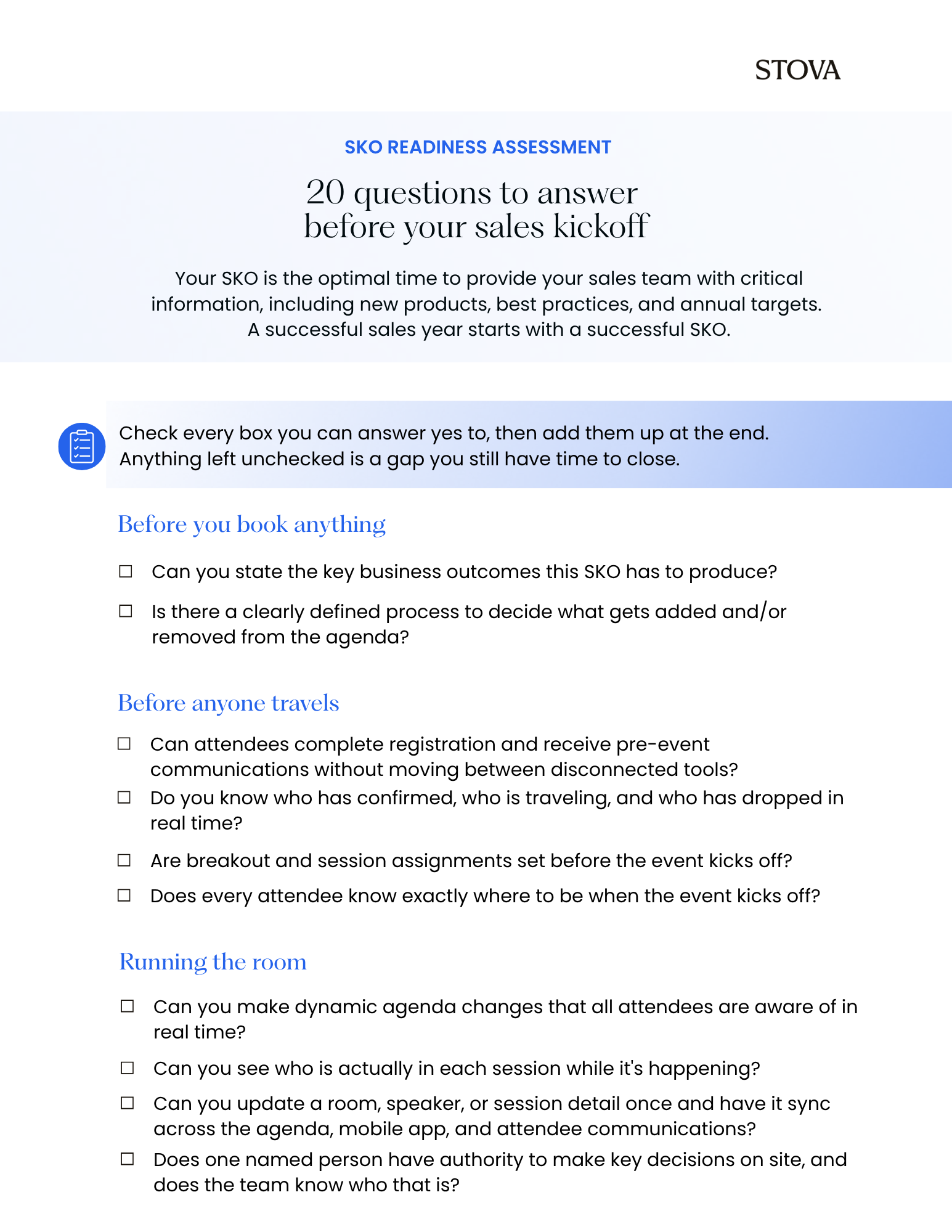
The SKO Readiness Assessment is a 20-question check across business outcomes, the attendee journey, session management, real-time visibility, and post-event measurement.
The score is useful; however, the unchecked boxes are where the value sits. Each one identifies a gap you still have time to close.